Challengingness
How difficult are different English consonants to learn?

My ‘day job’ is coaching multilingual professionals on how to speak English effectively. To have any success in this, it is generally useful to go back to the foundations of English speech and ensure that individual speech sounds are being correctly articulated. In fact, I strongly believe that this most basic of ‘levels’ is where English actually demands a significant level of accuracy, while giving us greater leeway to experiment with things like sentence stress, intonation, tempo, phrasing etc.
One of the most fascinating elements of this job is that I start to develop some generalisations: the sounds all speakers struggle with, the sounds speakers of certain languages tend to struggle with, the sounds that are generally not an issue. Then there are the anomalies - individual speakers who absolutely nail the tricky sounds but struggle with the ones they ‘should’ find easy.
I’ve been playing around with a bunch of numbers recently, trying to match my anecdotal data with something more empirical. My aim was to see if I could present some sort of visual data showing the likelihood that a non-native English speaker would find it difficult to correctly articulate a sound. So far I’ve just had a look at the (British) English consonant phonemes (as ever, I think the vowels will be more complex with a greater degree of susceptibility to perceptual difficulties, so I’ll do these later, hopefully, maybe…eventually).
Anyway, this is what I came up with:
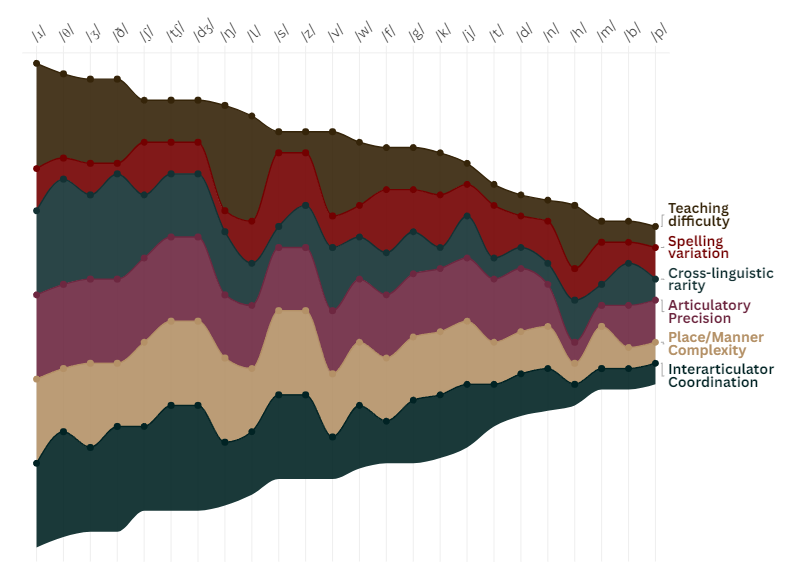
This is, clearly, not a rigorous scientific endeavour, but I think the results largely match what we might expect. The /ɹ/ is naturally the winner, with the interdental ‘th’ sounds (/θ/ and /ð/), the postalveolar fricatives and affricates, the /ŋ/ and the /l/ following close behind.
For reference, here’s some more detail on the variables I used:
Interarticulator coordination (score between 1 and 5): A score of 5 would denote multiple articulators needing to move in precise sequence or simultaneously. The interdental fricatives (the ‘th’ sounds) are prime candidates here, where timing of the tongue and teeth moving is critical.
Place/manner complexity (score between 1 and 5): How difficult is it for a learner to physically identify how and where the sound is being produced. Typically, plosives score low here, while affricates and approximants score high, with fricatives in the middle. The ‘th’ sounds score somewhere in the middle - you can, at least, see what you’re doing with these sounds!
Articulatory precision (score between 1 and 5): How much wiggle room do you have? Can you afford to get the tongue slightly out of place? The glottal fricative (/h/) would be an example with a low score here - you can’t go too far wrong with this, while the postalveolar fricative (‘sh’ sounds) scored more highly - a little bit forward and you have ‘s’.
Cross-linguistic rarity (score between 1 and 5): This used inventory data from phoible.org, and it reflects the proportion of languages’ phonetic inventories on which these sounds are found. A high score means the sounds are cross-linguistically rare, and means they are less likely to be familiar to speakers of other languages.
Spelling variation: this score was the total number of possible ways we spell the sound in (British) English, divided by two so that it didn’t swamp the other variables.
Teaching difficulty (score between 1 and 5): This is very qualitative - it is simply my own experience with each sound. A score of 5 means that, generally speaking, I have found this sound difficult to correct with my clients.
Let me know what you think, and as always, please consider subscribing!